

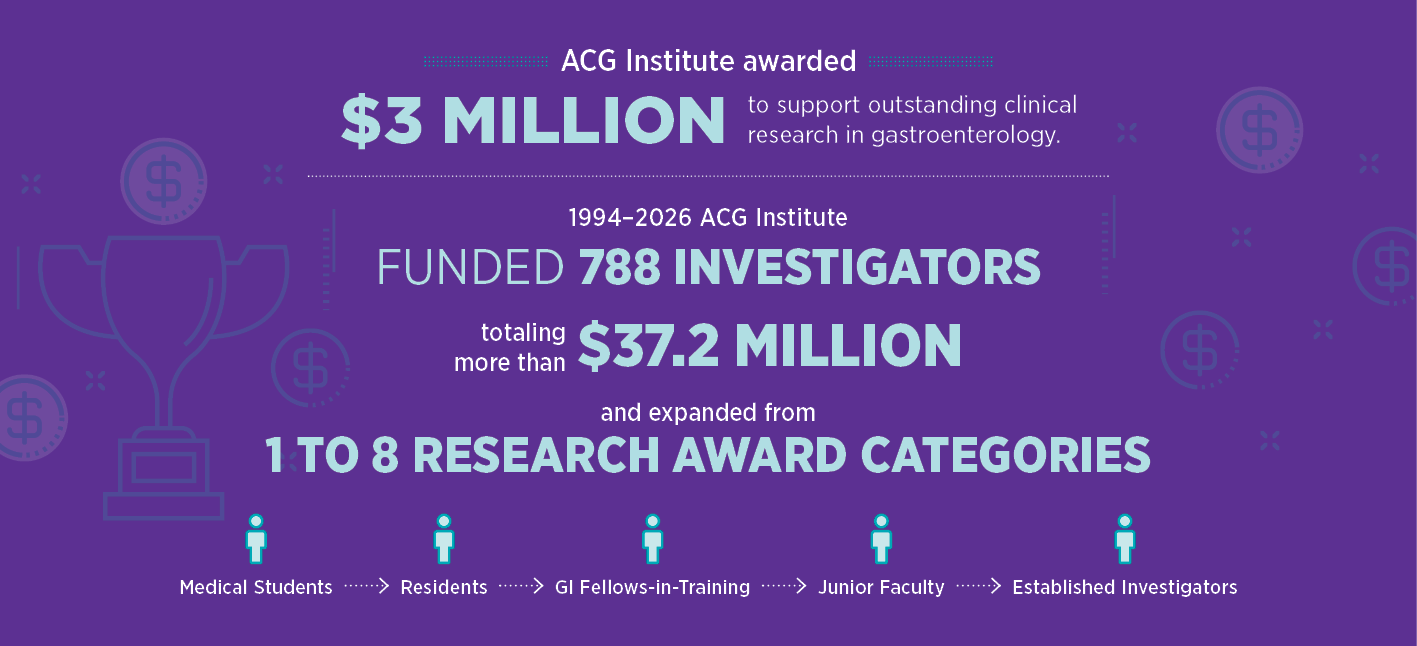
2026 ACG Junior Faculty Development Grant
The ACG Junior Faculty Development Award is a three-year award of $450,000, designed to support a junior faculty member of outstanding promise to establish an independent, productive career in gastroenterology or hepatology. This award of $150,000 per year for each of three years provides salary support for protected time to young investigators at critical points in their career development.

Massachusetts General Hospital
Lifestyle Determinants and Dietary Modulation of the Bile Acid-Microbiome Axis to Reduce Pouch Inflammation in Patients With Inflammatory Bowel Disease

University of California, San Francisco
Prevalence and Determinants of Anal HSIL in Patients With Perianal Crohn’s Disease

Northwestern University
Defining Optimal Therapeutic and Dilation Strategies in Eosinophilic Esophagitis Using AI and Real-World Data

Columbia University Irving Medical Center
Novel Approaches to Early Detection of Gastrointestinal Cancer for BRCA Carriers

The Cleveland Clinic Foundation
SOBER-VR: An AI-Powered Virtual Reality Brief Intervention for Hospitalized Patients With Alcohol-Associated Liver Disease
2026 ACG Established Investigator Bridge Funding Award
The ACG Established Investigator Bridge Funding Award is a two-year award supporting 30% protected time as bridge funding for established investigators. This bridge funding grant of $150,000 per year for 2 years is designed to support researchers principally focused on digestive or liver diseases, and to sustain their competitive, patient-oriented research programs during a gap in federal program funding.

Stanford University
Comprehensive Characterization of the Oral-Gastric Microbial Axis Within the Gastric Precancerous Cascade
2026 ACG Leonidas Berry Health Equity Research Award
The Leonidas Berry Health Equity Research Award (HERA) was re-named in honor of the life and legacy of Leonidas H. Berry, MD, MACG, ACG’s first African American member (1946) and champion of social change to de-segregate hospitals and medical schools. This award is a two-year award with funding up to $75,000 ($50,000 year-one, $25,000 year-two based on progress) to support actionable science that will translate to reducing health and/or healthcare disparities, thereby promoting health equity.

Indiana University
HOME-HCC: Home-Based Blood-Based Screening to Improve Hepatocellular Carcinoma Surveillance Equity

2026 ACG/ASGE Epidemiologic Research Award
in Gastrointestinal Endoscopy
The joint ACG/ASGE Epidemiologic Research Award in Gastrointestinal Endoscopy supports up to $50,000 for research projects involving the use and outcomes of gastrointestinal (GI) endoscopy using the GI Quality Improvement Consortium (GIQuIC).

University of Michigan
Patient, Procedure, and Practice Differences Between Male and Female Endoscopists
2026 ACG Clinical Research Awards
This year, The Institute increased the amount of support for original Clinical Research Awards offering awards in the amount of $100,000 (previously $50,000 per award). In 2026, 3 investigators were funded.

Massachusetts General Hospital; Harvard Medical School
Developing a Patient Decision Aid to Support Shared Decision Making for Older Adults With Inflammatory Bowel Disease

Indiana University School of Medicine
Defining the Role of Non-Heavy Alcohol Consumption in MASLD Severity, Progression, and Liver-Related Outcomes

Mayo Clinic Rochester
Development of a Noninvasive Metric to Measure Small Bowel Sensation – The Small Intestine Stress Test
2026 ACG Clinical Research Award Pilot Grant Recipients
This year, The Institute increased the amount of support for original Clinical Research Pilot Awards offering awards in the amount of $30,000 (previously $15,000 per award). In 2026, 3 investigators were funded.

University of California, San Francisco
Single-Cell and Spatial Analysis of Vascular Cell Interactions Driving Gastrointestinal Arteriovenous Malformations

Icahn School of Medicine at Mount Sinai
Biologic Chronotherapy in Inflammatory Bowel Disease: A Pilot Feasibility Study

Stanford School of Medicine
A Pilot Study Using Gut-Directed Hypnotherapy for Hospitalized Patients
2026 Medical Resident Clinical Research Award
The ACG Medical Resident Clinical Research Award is a one-year award in the amount of $10,000 for original clinical research. For 2026, 6 investigators were funded. This award separately supports travel to the ACG Annual Scientific Meeting.

Indiana University
The CarePal Study: Establishing a Digital Health Approach to Real-time Monitoring of Patient Reported Needs and Outcomes in Cirrhosis Care

University of California, San Francisco
Investigating Novel First-Line and Adjunct Therapies in Immune Checkpoint Inhibitor Hepatitis
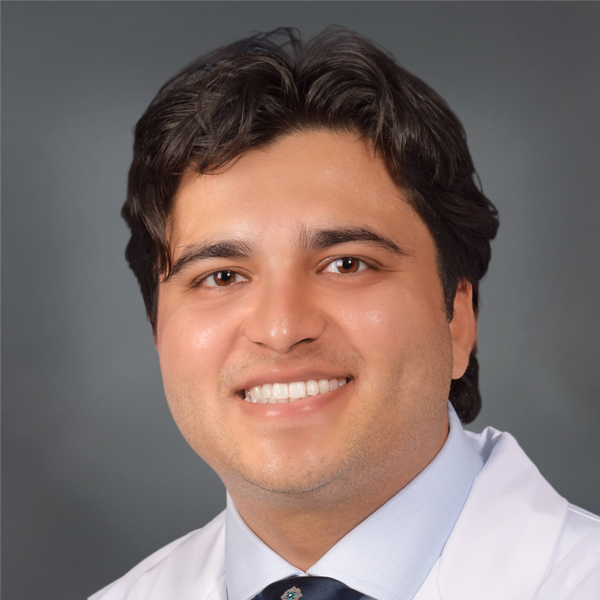
University of Pittsburgh, School of Medicine
Validating Iron Deficiency Anemia Diagnoses in a Longitudinal Nationwide Cohort to Improve Clinical Outcomes, Care Quality, and Research Rigor

Case Western Reserve University / MetroHealth
Investigating the Value of Supine and Upright Acid Exposure Time in Patients Undergoing Reflux Testing for the Diagnosis of Gastroesophageal Reflux Disease

NYU Grossman School of Medicine
Long-Term Adherence to Colorectal Cancer Screening and Surveillance in the Veterans Health Administration

Icahn School of Medicine at Mount Sinai
Optimizing Direct Access Screening Colonoscopy in a Large Integrated Health System
2026 Medical Student Research Award
The ACG Medical Student Research Award is an award for first, second, or third-year medical students, of up to $5,000 for a 6-10 week summer research project in gastroenterology or hepatology. For 2026, 4 medical students were funded. This award separately supports travel to the ACG Annual Scientific Meeting.

The Cleveland Clinic Foundation
Mechanisms of Inter-Individual Variability in Secretory IgA Responses to Dietary Fiber Supplementation

David Geffen School of Medicine at UCLA
Impact of Anti-Inflammatory vs. High-Fiber Diets on Clinical Outcomes in Inflammatory Bowel Disease

Mayo Clinic Rochester
Characterizing the Senescence Associated Secretory Phenotype in Cirrhosis and Its Role in Sarcopenia

Indiana University School of Medicine
Risk Stratification of Patients With Serrated Polyposis Syndrome: Determining Outcomes, Safety, and Cost of Extending Colonoscopy Surveillance Intervals