

Surveillance Endoscopy in Barrett’s Esophagus: Does It Work?
 Margaret J. Zhou, MD, MS

Clinical Assistant Professor of Medicine, Division of Gastroenterology & Hepatology, Stanford University, Stanford, CA
This summary reviews Old O, Jankowski J, Attwood S, et al; BOSS Trial Team. Barrett’s Oesophagus Surveillance Versus Endoscopy at Need Study (BOSS): A Randomized Controlled Trial. Gastroenterology. 2025 Apr 1:S0016-5085(25)00587-6.
Correspondence to Margaret Zhou, MD, MS. Associate Editor. Email: EBGI@gi.org
Keywords: Barrett’s esophagus; endoscopy; esophageal adenocarcinoma; RCT
STRUCTURED ABSTRACT
Question: In patients with Barrett’s esophagus (BE), does scheduled surveillance endoscopy improve overall survival compared to endoscopy at-need?
Design: Randomized controlled trial (RCT).
Setting: One hundred nine centers in the United Kingdom.
Patients: Individuals ages 18 years or older with non-dysplastic BE (NDBE) or BE with low-grade dysplasia (LGD) diagnosed within 2 years of study recruitment. Patients with high-grade dysplasia (HGD), esophageal adenocarcinoma (EAC), or a history of upper gastrointestinal (GI) cancers were excluded.
Interventions: Patients were randomized to scheduled endoscopic surveillance every 2 years (+/- 3 months) with 4-quadrant biopsies taken every 2 cm or endoscopy at-need (performed for evaluation of symptoms). In both arms, patients were offered endoscopy if they developed dysphagia, unexplained weight loss of >7 lb. iron-deficiency anemia, recurrent vomiting, or worsening upper GI symptoms. Minimum follow-up time was 10 years.
Patients in the at-need endoscopy arm were offered an exit endoscopy, which was recommended by the Data and Safety Monitoring Committee after review of interim trial data. Patients, clinicians, and researchers were aware of the allocated study arm.
Outcomes: The primary outcome was overall survival from the time of randomization to death of any cause. Patients who did not have an event were censored at whichever was first of the date of complete study withdrawal or end of follow-up.
Secondary outcomes included 1) cancer-specific survival, defined as death from all cancers; 2) time to diagnosis of EAC; 3) stage of EAC at diagnosis; 4) serious adverse events related to endoscopy; and 5) frequency of endoscopy.
Data Analysis: Study design was specified for a superiority trial for the primary outcome of overall survival, estimating that 3,400 patients were needed to detect a hazard ratio (HR) of 1.3 at 93% power. All analyses used the intention-to-treat population.
Funding: Health Technology Assessment Programme, United Kingdom.
Results: The study recruited 3,453 patients from March 2009 – November 2011, with 1,733 patients randomized to scheduled surveillance endoscopy and 1,719 patients to endoscopy at-need. Median follow-up was 12.8 years, including 39,512 total patient-years of follow-up.
Mean age at randomization was 63 years, men comprised 71% of participants, and long-segment BE was found in 56%. LGD was present in 1% of patients before trial enrollment. Intestinal metaplasia was present in 75% of patients. Loss to follow-up occurred in 5.2% of all participants (6.7% in the scheduled surveillance arm vs. 3.6% in the endoscopy at-need arm).
In total, 333 deaths (19.2%) occurred in the scheduled surveillance arm vs 356 deaths (20.7%) in the endoscopy at-need arm, corresponding to a HR for overall survival (OS) of 0.95 (95% confidence interval [CI] 0.82-1.10; log-rank P = 0.52) (Table 1). Deaths from any cancer occurred in 108 patients in the scheduled surveillance arm (32.4%) vs 106 patients in the at-need endoscopy arm (29.8%) (HR 1.01; 95% CI 0.77-1.33, log-rank P = 0.76). Death from esophageal cancer occurred in 22 patients in the scheduled surveillance arm (1.2%) vs 19 patients in the endoscopy at-need arm (1.1%).
Forty patients (2.3%) in the surveillance arm were diagnosed with EAC vs 31 patients (1.8%) in the at-need arm (HR 1.32; 95% CI 0.82-2.11, log-rank P = 0.210). This included 18 patients in the surveillance arm vs 12 patients in the at-need arm with T1, T1a, or T1b cancers. Few patients were diagnosed with nodal or metastatic disease, but these proportions were similar between the 2 groups.
In the surveillance arm, 1,606 patients (93%) underwent at least 1 endoscopy during the study period compared to 1,006 (59%) of patients in the at-need arm. Median interval between endoscopies was 24.8 months in the surveillance arm vs 25.7 months in the at-need arm.
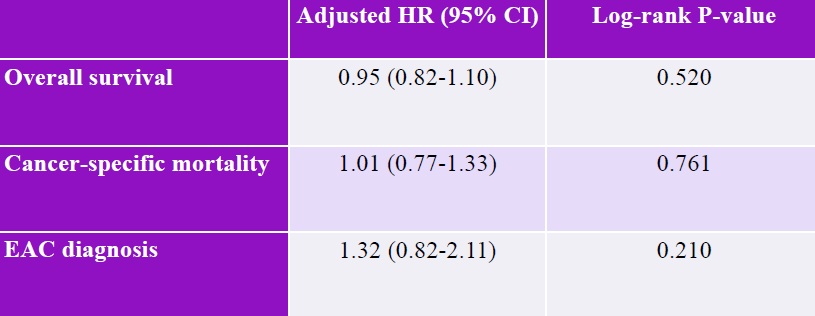
Table 1. Results from adjusted Cox regression models comparing scheduled surveillance endoscopy vs at-need endoscopy.a
a Adjusted models included all randomization factors as well as prognostic factors including sex, indefinite or low-grade dysplasia, obesity, and time from BE diagnosis to trial entry.
COMMENTARY
Why Is This Important?
This is the first RCT to study endoscopic surveillance in BE and the largest existing RCT of patients with BE.
Key Study Findings
Caution
This is an important and needed study to understand the impact of endoscopic surveillance in BE. However, the study conclusion that there was no statistically significant difference in outcomes, specifically overall survival, between patients in the scheduled surveillance vs. at-need endoscopy arms should be interpreted cautiously due to several limitations.
This study was likely underpowered to detect a difference in all-cause mortality due to the sample size calculation being based on a relatively large HR of 1.3. The authors acknowledge that at the time the trial began in 2009, the risk of progression of BE to EAC was estimated to be closer to 1% per year, whereas progression based on more recent data is estimated to be closer to 0.2% per year.1, 2 Thus, the sample size needed to detect a difference between groups is likely much larger than was calculated and recruited for this study. Furthermore, the study did not address the important question of whether surveillance endoscopy impacted EAC-related mortality. The study did report on esophageal cancer-related mortality but did not specify whether these were cases of EAC or esophageal squamous cell carcinoma, which is important to differentiate in a BE cohort.
There was significant cross-contamination between treatment arms, as a large proportion of patients (59%) in the endoscopy at-need arm underwent at least 1 endoscopy during the study period. Patients in the at-need arm underwent endoscopy at almost the same surveillance interval as the scheduled surveillance arm (25.7 months in the at-need arm vs 24.8 months in the scheduled surveillance arm). This likely biased the study results towards the null.
Of note, 25% of patients did not have intestinal metaplasia (IM) on pathology, which may make extrapolation to US-based BE cohorts challenging as IM is required for diagnosis of BE based on American guidelines. This may have further biased the study towards the null given that progression rates of columnar-lined mucosa without pathologically confirmed IM to EAC is lower than that of IM.1
Lastly, the study did not provide data on the quality of surveillance endoscopy, such as adherence to Seattle protocol biopsies or use of advanced imaging techniques. The high proportion of T2 cancers in the scheduled surveillance arm (35% of EACs) was similar to the at-need arm (32% of EACs).3, 4 These proportions are higher than reported in other BE cohorts, which raises the question of possible missed lesions or endoscopic quality in the surveillance arm.
My Practice
Current guidelines recommend surveillance endoscopy every 3-5 years for patients with NDBE.5 Based on this study, it is difficult to conclude that there was no benefit with scheduled surveillance endoscopy, and I do not plan to change my approach to endoscopic surveillance. In my patients with NDBE, I generally perform endoscopic surveillance every 3 years and discuss with patients the option of surveillance every 5 years if they have short-segment BE without any other significant risk factors for EAC (i.e., family history of EAC, tobacco use, obesity). During surveillance endoscopy, I perform a high-quality endoscopy using a distal attachment cap with both white-light and virtual chromoendoscopy (most frequently, narrow band imaging in my practice). I also aim to spend adequate time inspecting the BE segment (approximately 1 minute per centimeter of BE) and adhere to Seattle protocol biopsies (4-quadrant biopsies every 2 cm for NDBE or every 1 cm for patients with a history of dysplasia) with separate biopsies taken for visible lesions. The quality of endoscopy has been associated with improved neoplasia detection in BE cohorts and likely has a significant impact on the efficacy of surveillance programs.
For Future Research
While an additional RCT with a larger sample size may be helpful to address the limitations of this study, conducting another RCT on endoscopic surveillance in BE will be very challenging. Instead, further study on the use of risk stratification tools or biomarkers to help with predicting progression to HGD/EAC may provide more personalized surveillance strategies for patients with BE. Furthermore, additional research on quality metrics in endoscopy for BE is needed, as there are currently no widely established quality metrics to assess BE care.
Conflicts of Interest
Dr. Zhou reports no conflicts of interest related to this study.
Abbreviations
BE, Barrett’s esophagus; CI, confidence interval; EAC, esophageal adenocarcinoma; HGD, high-grade dysplasia; HR, hazard ratio; IM, intestinal metaplasia; LGD, low-grade dysplasia; NDBE, non-dysplastic BE; OS, overall survival; RCT, Randomized controlled trial.
REFERENCES
- Bhat S, Coleman HG, Yousef F, Johnston BT, McManus DT, Gavin AT, Murray LJ. Risk of malignant progression in Barrett’s esophagus patients: results from a large population-based study. J Natl Cancer Inst. 2011 Jul 6;103(13):1049-57. Erratum in: J Natl Cancer Inst. 2013 Apr 17;105(8):581.
- Hvid-Jensen F, Pedersen L, Drewes AM, Sørensen HT, Funch-Jensen P. Incidence of adenocarcinoma among patients with Barrett’s esophagus. N Engl J Med. 2011 Oct 13;365(15):1375-83.
- Grant KS, DeMeester SR, Kreger V, Oh D, Hagen JA, Chandrasoma P, DeMeester TR. Effect of Barrett’s esophagus surveillance on esophageal preservation, tumor stage, and survival with esophageal adenocarcinoma. J Thorac Cardiovasc Surg. 2013;146(1):31-7. 4.
- Codipilly DC, Chandar AK, Singh S, et al. The effect of endoscopic surveillance in patients with Barrett’s esophagus: A systematic review and meta-analysis. Gastroenterology. 2018;154(8):2068-2086.e55.
- Shaheen NJ, Falk GW, Iyer PG, Souza RF, Yadlapati RH, Sauer BG, Wani S. Diagnosis and management of Barrett’s esophagus: An updated ACG guideline. Am J Gastroenterol. 2022 Apr 1;117(4):559-587.