

Colonoscopy and FIT Shift CRC Detection Toward Earlier Stages: Results from the SCREESCO Trial
 Samuel Schueler, MD1 and Romy Chamoun, MD2

1Assistant Professor of Medicine, Gastroenterology & Liver Disease
2GI Fellow, George Washington University School of Medicine & Health Sciences, Washington, DC
This summary reviews Westerberg M, Ludvigsson, JF, Metcalfe C, et al. Colonoscopy and fecal immunochemical testing versus usual care in diagnostic colorectal cancer screening: the SCREESCO randomized controlled trial. Nat Med. 2026; 32: 1278-128
Access the article through PubMed
Correspondence to Romy Chamoun, MD. Associate Editor. Email: EBGI@gi.org
Keywords: Colonoscopy, colorectal cancer screening, fecal immunochemical testing
STRUCTURED ABSTRACT
Question: Does colorectal cancer (CRC) screening with primary colonoscopy or fecal immunochemical testing (FIT) improve early cancer detection compared with usual care, and what are the associated harms?
Design: This study is a randomized controlled trial (RCT) applying a randomized controlled block method.
Setting: The study was set across eighteen Swedish regions without established organized CRC screening programs.
Patients: The patients in the trial were 278,051 average-risk individuals aged 60 years randomized to colonoscopy, FIT, or usual care. The median follow-up was 4.8 years.
Intervention/Exposure: Participants were randomized to once-only screening colonoscopy, 2 rounds of 2-stool FIT performed 2 years apart using a low positivity threshold (10 μg hemoglobin/g feces), and usual care without organized screening.
Outcomes: The outcomes patients faced were CRC incidence, CRC stage at diagnosis, gastrointestinal adverse events, cardiovascular adverse events, and all-cause mortality.
Data Analysis: Intention-to-screen analysis using incidence rate ratios comparing intervention groups with controls.
Funding: Supported by Swedish governmental and research funding agencies.
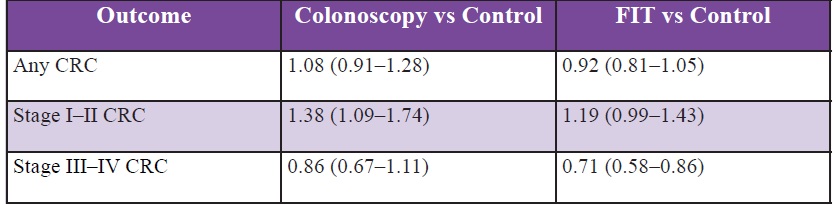
Results: Compared to usual care, both screening strategies resulted in a shift toward earlier-stage CRC diagnosis (Table 1).
COMMENTARY
Why Is This Important?
CRC screening is one of the most successful cancer prevention strategies, reducing both CRC incidence through adenoma removal and CRC mortality through earlier cancer detection. Colonoscopy and FIT are the 2 most widely used screening modalities and are recommended by multiple professional societies. However, few contemporary randomized trials have compared these screening approaches against an unscreened population, making it difficult to quantify the overall benefits and harms attributable to screening itself.
The SCREESCO trial addresses this important knowledge gap by comparing colonoscopy-based screening, FIT-based screening, and usual care in a large average-risk population. Unlike studies that focus solely on CRC mortality, SCREESCO provides insight into what occurs during the diagnostic phase of screening, including cancer detection, stage distribution, and procedure-related adverse events. Understanding these early outcomes is important because a shift toward detection of stage I–II cancers and away from advanced-stage disease is often the first measurable indicator that a screening program may ultimately improve long-term CRC outcomes.
As healthcare systems continue to expand organized CRC screening programs and seek strategies that maximize participation, the results of SCREESCO provide valuable evidence supporting both colonoscopy and FIT as effective screening approaches. These findings help inform discussions between providers, patients, and policymakers regarding the implementation of population-based CRC screening programs and the balance between screening benefits and associated risks.
Key Study Findings
Caution
SCREESCO reports early outcomes from the diagnostic phase of screening rather than the long-term outcomes that matter most to patients, including CRC incidence and CRC mortality. This analysis represents the diagnostic phase of screening with a median follow-up of 4.8 years and was not designed to assess the effect of screening on CRC mortality. While the observed shift toward earlier-stage disease is encouraging, additional follow-up is needed to determine whether these findings translate into meaningful reductions in CRC-related deaths. Participation rates were lower than anticipated, particularly in the colonoscopy arm, which may attenuate the benefits observed in this intention-to-screen analysis. Longer follow-ups through 2030 are planned.
Our Practice
In our practice, we begin CRC screening starting at age 45 years for patients assessed to be at average risk for CRC. The decision to continue or stop screening after age 75 years is individualized. All screening options are reviewed with patients, including colonoscopy, stool tests, blood tests, and imaging.
No current screening modality has 100% sensitivity for CRC detection. While colonoscopy and stool-based tests are both considered first line screening modalities for CRC, that does not make them equivalent. We specifically address the difference in sensitivity in detecting pre-cancerous polyps. While colonoscopy is considered to be 90-95% sensitive for detection of advanced colon polyps, FIT testing is ~25% sensitive, and multitarget stool DNA testing (mt-sDNA) is ~45% sensitive. We simplify this for patients by saying that colonoscopy will capture the majority of these lesions while stool and blood tests will miss more than half.
When a patient opts for stool-based testing, we emphasize the differences between FIT and mt-SDNA. FIT is readily available at the lab in our clinic, meaning patients can complete the test on the same day or at least pick up a stool collection kit on the same day and later submit the test to our lab or to many nearby labs which may be closer to where they live. Only a small stool sample is required for the test. A mt-sDNA is a send-out test and requires collection of a full bowel movement, which may be perceived as additional barriers in some patients. Advantages of mt-sDNA include potentially higher sensitivity for both CRC and precancerous colon polyps and only needing to perform the test every 3 years (vs annually for FIT). Conversely, mt-sDNA may have a higher false-positive rate (decreased specificity) as compared to FIT, potentially leading to more downstream colonoscopies for patients who may have been hoping to avoid colonoscopy in the first place.
For patients and providers trying to understand the benefits and risks of CRC screening via colonoscopy or FIT, the SCREESCO study provides valuable data we can share with our patients to help them make informed decisions. An important caveat in extrapolating the FIT data from this study to patients in the United States is to highlight that while the SCREESCO trial used a two-stool FIT protocol, we typically perform annual single-sample testing in the United States.
Future Research
Future studies should evaluate whether intervention strategies that target low-value surveillance colonoscopy can be implemented without compromising patient outcomes. Research is also needed to identify barriers to guideline adherence among endoscopists and patients, assess the effectiveness of decision-support tools integrated into electronic health records, and determine whether personalized surveillance recommendations based on individual risk factors can further optimize colonoscopy utilization while maintaining colorectal cancer prevention benefits.
Conflict of Interest
The authors report no relevant conflicts of interest related to this commentary.