

The Updated ACG Guidelines to Manage Adult Ulcerative Colitis Patients
 Elie S. Al Kazzi, MD, MPH

Assistant Professor of Medicine, New York University Grossman School of Medicine, New York, NY
This summary reviews Rubin DT, Ananthakrishnan AN, Siegel CA, Barnes EL, Long MD. ACG Clinical Guideline Update: Ulcerative Colitis in Adults. Am J Gastroenterol. 2025 Jun 3;120(6):1187-1224.
Access the Guideline through The American Journal of Gastroenterology.

Correspondence to Elie S. Al Kazzi, MD, MPH, Associate Editor Email: EBGI@gi.org
Keywords: Guideline, ulcerative colitis, inflammatory bowel disease
STRUCTURED ABSTRACT
Question: How can healthcare providers manage ulcerative colitis (UC) in adults? What are appropriate therapies for mild-to-moderate disease, moderate-to severe disease and the hospitalized patient?
Design: GRADE methodology was used to assess benefits and risks of therapies and diagnostic tests. When the evidence was not appropriate for the GRADE process, an expert consensus approach was used to formulate key concepts statement. The Patient Intervention Comparison and Outcomes (PICO) format was used to develop key questions of clinical relevance to be addressed in the guideline. The primary aim of treatment is to achieve and maintain long-term remission without the use of steroids, while also ensuring adequate psychosocial support, a normal health-related quality of life (HRQoL), and social well-being. Additional goals include preventing complications such as hospitalizations, surgeries, and cancer.
Patients: Adult patients with diagnosed ulcerative colitis, whose disease severity is mild-to-moderate or moderate-to-severe or who are hospitalized with acute severe UC (ASUC).
Interventions/Exposure: Below is a list of terms of risk factors and interventions used in these guidelines for the management of UC.
Diagnostic testing: Clostridium difficile testing, serological testing, colonoscopy/sigmoidoscopy, intestinal ultrasounds, disease extent, clinical disease severity, endoscopic disease severity such as the Mayo Endoscopic Score (MES) or the UC Endoscopic Index of Severity (UCEIS), biomarkers use such as C-reactive protein (CRP) and fecal calprotectin (FC), treat-to-target such as endoscopic improvement to MES 0 or MES 1, disease monitoring, extraintestinal manifestations, and screening for coexistent anxiety and depressive disorders.
Treatment: Induction and maintenance therapy strategies, monotherapy or combination therapy, escalation of therapy, topical or systemic 5-ASA therapies, tacrolimus suppositories, topical or systemic steroids, thiopurines, methotrexate, S1P receptor modulators (ozanimod and etrasimod), IL-12/23p40 antibody (ustekinumab), IL23p19 inhibitor (guselkumab, mirikizumab, or risankizumab), anti-integrin (vedolizumab), anti-TNF (infliximab, adalimumab, golimumab), JAK inhibitor (tofacitinib, or upadacitinib), therapeutic drug monitoring (TDM), pharmacologic deep vein thrombosis DVT prophylaxis, broad-spectrum antibiotics, total parenteral nutrition, IV corticosteroids, medical rescue therapy (infliximab, JAK inhibitors or cyclosporine), fecal microbiome transplant, curcumin/QingDai, alternative therapies, nonresponders, biosimilars, positioning of therapy, and surgeries.
Outcomes: Sustained and durable steroid-free remission, accompanied by appropriate psychosocial support, normal HRQoL and social functioning, prevention of morbidity including hospitalization and surgery, and prevention of cancer.
Data analysis: The GRADE methodology1,2 uses 2 types of guideline recommendations, strong and conditional. With a strong recommendation, providers should recommend the intervention for most patients. A strong recommendation is usually accompanied by High or Moderate Level of Evidence from well-designed randomized controlled trials (RCTs) or RCTs with mild methodologic limitations. With a conditional recommendation, providers might suggest this therapy or diagnostic test, while other providers would not suggest this intervention in similar patients. Conditional recommendations are usually accompanied by Low quality or Very Low quality of evidence from studies without a comparator arm or placebo for comparison.
Funding: The American College of Gastroenterology, through the Practice Parameters Committee.
Results: Recommendations and key concepts can be found in Tables 1 and 2. Adult patients with UC should seek appropriate testing at presentation, ruling out infectious etiologies especially C. difficile. Disease severity and disease extent are important disease characteristics to be established for each patient and at each clinical encounter. These can be of clinical nature in addition to biochemical markers such as CRP and FC, and endoscopic and histologic characteristics. Once the disease has been established and well characterized, physicians and APPs, and patients should aim to get to an informed clinical and surgical therapy plan ranging from topical and systemic 5-ASA agents to advanced therapy. Patient are to be monitored regularly, especially when starting a new therapy (ideally at 8 weeks) to assess for clinical remission and endoscopic remission. Our current treat-to-target is endoscopic remission. Though it has been associated with some improvement of clinical outcomes, histological remission lacks enough evidence to be a favored target-to-treat at the moment.
There are multiple approved therapies for maintenance in UC patients, with different routes of administration. The current guidelines provide evidence and data on the different levels of remission a patient can achieve for each one. Of note, biosimilars for anti-TNF agents and ustekinumab are acceptable alternatives for the originator therapy without any delays in treatment.
The hospitalized UC patient with ASUC should be tested for C. difficile infection at presentation. Chemical DVT prophylaxis and initiation of IV corticosteroids are standards of care. Patients should be adequately monitored for clinical improvement prior to initiating rescue therapy. Figure 1 describes an algorithm to guide the management of the hospitalized patient with ASUC.
Table 1: Summary and Strength of GRADED recommendations for the management of ulcerative colitis.
DIAGNOSIS, ASSESSMENT, MONITORING, AND PROGNOSIS OF UC
1. We recommend stool testing to rule out Clostridioides difficile in patients suspected of having UC (Strong recommendation, very low quality of evidence).
2. We recommend against serologic antibody testing to establish or rule out a diagnosis of UC (Strong recommendation, very low quality of evidence).
3. We recommend against serologic antibody testing to determine the prognosis of UC (Strong recommendation, very low quality of evidence
GOALS FOR MANAGING PATIENTS WITH UC
4. We recommend treating patients with UC to achieve endoscopic improvement (defined as resolution of inflammatory changes [MES 0 or 1]) to increase the likelihood of sustained steroid-free remission and to prevent hospitalizations and surgery (Strong recommendation, moderate quality of evidence).
5. We recommend the use of FC in UC to assess response to therapy, to evaluate suspected relapse, and during maintenance (Strong recommendation, moderate quality of evidence).
MANAGEMENT OF MILDLY TO MODERATELY ACTIVE UC
Induction and maintenance of remission in mildly to moderately active UC
6. In patients with mildly to moderately active ulcerative proctitis, we recommend rectal 5-aminosalicylate acid (5-ASA) therapies at a dose of 1 g/daily for induction of remission (Strong recommendation, moderate quality evidence).
7. For patients with mildly to moderately active proctitis not responsive to topical 5-ASA, we suggest tacrolimus suppository or beclomethasone suppository over no treatment (Conditional recommendation, low quality of evidence).
8. For patients with mildly to moderately active proctitis or left-sided colitis, we suggest use of topical corticosteroids (suppository, foam, enema), over no treatment (Conditional recommendation, very low quality of evidence).
9. In patients with mildly to moderately active proctitis or left sided colitis, we recommend rectal 5-ASA enemas at a dose of at least 1 g/daily preferred over rectal steroids for induction of remission (Strong recommendation, moderate quality of evidence).
10. In patients with mildly to moderately active left-sided UC, we suggest rectal 5-
ASA enemas at a dose of at least 1 g/daily combined with oral 5-ASA at a dose of at least 2.0 g/daily compared with oral 5-ASA therapy alone for induction of remission (Conditional recommendation, low quality of evidence).
11. In patients with mildly to moderately active left-sided UC, who are intolerant or nonresponsive to oral and rectal 5-ASA at appropriate doses (oral at least 2.0 g daily and rectal at least 1 g daily), we recommend oral budesonide Multi Matrix System (MMX) 9 mg/d for induction of remission (Strong recommendation, moderate quality of evidence).
12. In patients with mildly to moderately active extensive colitis, oral 5-ASA at
a dose of at least 2.0 g daily is recommended to induce remission (Strong recommendation, moderate quality of evidence).
13. In patients with UC of any extent who fail to respond to 5-ASA therapy, we recommend oral systemic corticosteroids to induce remission (Strong recommendation, low quality of evidence).
14. In patients with mildly to moderately active UC who fail to reach remission with appropriately dosed 5-ASA (at least 2–4.8 g daily oral mesalamine and/or at least 1 g daily rectal mesalamine), we suggest against changing to an alternate 5-ASA formulation to induce remission. Alternative therapeutic classes should be considered (Conditional recommendation, low quality of evidence).
15. In patients with mildly active UC of any extent, we suggest using a low dose (2.0–2.4 g) of 5-ASA, in comparison with a higher dose (4.8 g), because there is no difference in remission rate (Conditional recommendation, very low quality of evidence).
16. In patients with mildly to moderately active UC of any extent not responding to oral 5-ASA, we recommend the addition of budesonide MMX 9 mg/d to induce remission (Strong recommendation, moderate quality of evidence).
17. In patients with mildly to moderately active UC of any extent using 5-ASA to induce remission, we recommend either once daily or more frequently dosed oral 5-ASA based on patient preference to optimize adherence because efficacy and safety are no different (Strong recommendation, moderate quality evidence).
18. In patients with mildly active ulcerative proctitis, we recommend rectal 5-ASA at a dose of 1 g daily for maintenance of remission (Strong recommendation, moderate quality of evidence).
19. In patients with mildly active left-sided or extensive UC, we recommend oral 5-
ASA therapy (at least 1.5 g/d) for maintenance of remission (Strong recommendation, moderate quality of evidence).
20. We recommend against systemic, budesonide MMX, or topical corticosteroids for maintenance of remission in patients with UC (Strong recommendation, moderate quality of evidence).
INDUCTION OF REMISSION IN MANAGEMENT OF MODERATELY TO SEVERELY ACTIVE ULCERATIVE COLITIS
21. In patients with moderately active UC, we recommend oral budesonide MMX for induction of remission (Strong recommendation, moderate quality of evidence).
22. In patients with moderately to severely active UC of any extent, we recommend oral systemic corticosteroids to induce remission (Strong recommendation, low quality of evidence).
23. In patients with moderately to severely active UC, we recommend against monotherapy with thiopurines or methotrexate for induction of remission (Strong recommendation, low quality of evidence).
24. In patients with moderately to severely active UC, we recommend sphingosine-1-phosphate (S1P) receptor modulators, ozanimod and etrasimod, for induction of remission (Strong recommendation, moderate quality of evidence).
25. In patients with moderately to severely active UC, we recommend the interleukin (IL)-12/23p40 antibody ustekinumab for induction of remission (Strong recommendation, moderate quality of evidence).
26. In patients with moderately to severely active UC, we recommend the IL23p19 inhibitor guselkumab, mirikizumab, or risankizumab for induction of remission (Strong recommendation, moderate quality of evidence).
27. In patients with moderately to severely active UC, we recommend vedolizumab for induction of remission (Strong recommendation, moderate quality of evidence).
28. In patients with moderately to severely active UC, we recommend anti-tumor necrosis factor (TNF) therapy using infliximab for induction of remission (Strong recommendation, high quality of evidence).
29. In patients with moderately to severely active UC, we recommend anti-TNF therapy using adalimumab or golimumab for induction of remission (Strong recommendation, moderate quality of evidence).
30. In patients with moderately to severely active UC, we recommend the Janus kinase (JAK) inhibitor tofacitinib for induction of remission (Strong recommendation, moderate quality of evidence).
31. In patients with moderately to severely active UC, we recommend the JAK inhibitor upadacitinib for induction of remission (Strong recommendation, high quality of evidence).
32. In patients with moderately to severely active UC who have failed 5-ASA therapy and in whom advanced therapies with biologics or JAK inhibitors are used for induction of remission, we suggest against using 5-ASA for added clinical efficacy (Conditional recommendation, very low quality of evidence).
33. When infliximab is used as induction therapy for patients with moderately to severely active UC, we recommend combination therapy with a thiopurine (Strong recommendation, moderate quality of evidence for azathioprine).
MAINTENANCE OF REMISSION IN PATIENTS WITH PREVIOUSLY MODERATELY TO SEVERELY ACTIVE UC
34. In patients with prior moderately to severely active UC who have achieved remission but previously failed 5-ASA therapy and are now on anti-TNF therapy, we suggest against using concomitant 5-ASA for efficacy of maintenance of remission (162) (Conditional recommendation, low quality of evidence).
35. In patients with prior moderately to severely active UC, we recommend against systemic corticosteroids for maintenance of remission (Strong recommendation, moderate quality of evidence).
36. For patients with prior moderately to severely active UC now in remission because of corticosteroid induction, we suggest thiopurines for maintenance of remission as compared with no treatment or corticosteroids (Conditional recommendation, low quality of evidence).
37. In patients with prior moderately to severely active UC now in remission, we suggest against using methotrexate for maintenance of remission (Conditional recommendation, low quality of evidence).
38. We recommend continuing S1P receptor modulators ozanimod or etrasimod for maintenance of remission as compared wih no treatment after induction of remission with these agents (Strong recommendation, moderate quality of evidence).
39. We recommend continuing ustekinumab for maintenance of remission as compared to no treatment in patients who responded to the induction dose of this medication (Strong recommendation, moderate quality of evidence).
40. We recommend continuing guselkumab, mirikizumab, or risankizumab as compared with no treatment for maintenance of remission in patients who respond to the induction dosing of the same treatment (Strong recommendation, moderate quality of evidence).
41. We recommend continuing vedolizumab as compared with no treatment for maintenance of remission (intravenous [IV] or subcutaneous [SC] dosing) in patients with prior moderately to severely active UC now in remission after vedolizumab induction (Strong recommendation, moderate quality of evidence).
42. We recommend continuing anti-TNF therapy using adalimumab, golimumab, or infliximab (IV or SC dosing) for maintenance of remission after anti-TNF induction in patients with prior moderately to severely active UC (Strong recommendation, moderate quality of evidence).
43. We recommend continuing tofacitinib or upadacitinib as compared with no treatment for maintenance of remission in patients with prior moderately to severely active UC now in remission after induction with tofacitinib or upadacitinib (Strong recommendation, moderate quality of evidence).
POSITIONING CONSIDERATIONS FOR THE PATIENT WITH MODERATELY TO SEVERELY ACTIVE UC
44. In patients with moderately to severely active UC who are responders to anti-TNF therapy and now losing response, we suggest measuring serum drug levels and antidrug antibodies (if there is not sufficient drug present) to assess reason for loss of response (Conditional recommendation, very low quality of evidence).
45. In patients with moderately to severely active UC, we recommend vedolizumab as compared with adalimumab for induction and maintenance of remission (Strong recommendation, moderate quality of evidence).
MANAGEMENT OF THE HOSPITALIZED PATIENT WITH ACUTE SEVERE UC
46. In patients with acute severe UC (ASUC), we recommend testing for CDI (Strong recommendation, moderate quality of evidence).
47. In patients with ASUC, we recommend pharmacologic DVT prophylaxis as compared with no prophylaxis to prevent VTE (Strong recommendation, low quality of evidence).
48. We recommend against routine use of broad-spectrum antibiotics in the management of ASUC (Strong recommendation, low quality of evidence).
49. We suggest against total parenteral nutrition for the purpose of bowel rest in ASUC (Conditional recommendation, very low quality of evidence).
50. In patients with ASUC, we recommend a total of 60 mg/d of methylprednisolone or hydrocortisone 100 mg 3 or 4 times per day to induce remission (Strong recommendation, low quality of evidence).
51. In patients with ASUC failing to adequately respond to intravenous corticosteroids (IVCS) by 3 days, we recommend medical rescue therapy with infliximab or cyclosporine (Strong recommendation, moderate quality of evidence).
52. In patients with ASUC who achieve remission with infliximab treatment, we recommendmaintenance of remissionwiththe same agent (Strong recommendations, moderate quality of evidence).
53. In patients with ASUC who achieve remission with cyclosporine treatment, we suggest maintenance of remission with thiopurines (Conditional recommendation, low quality of evidence).
54. In patients with ASUC who achieve remission with cyclosporine treatment, we suggest maintenance of remission with vedolizumab (Conditional recommendation, very low quality of evidence).
Abbreviations: 5-ASA, 5-aminosalicylic acid; ASUC, acute severe ulcerative colitis; DVT, deep vein thrombosis; FC, fecal calprotectin; IL, interleukin; IV, intravenous; IVCS, intravenous corticosteroids; JAK, Janus kinase; MMX, Multi Matrix System; SC, subcutaneous; S1P, sphingosine-1-phosphate; TNF, tumor necrosis factor; UC, ulcerative colitis; VTE, venous thromboembolism.
2. Infectious etiologies should be excluded at the time of diagnosis.
3. Colonoscopy with intubation of the ileum and biopsies of affected and unaffected areas should be obtained to confirm the diagnosis of UC, with mucosal biopsies interpreted by a pathologist, preferably one with expertise in gastrointestinal pathology.
4. Categories of disease extent include (i) proctitis (within 18 cm of anal verge, distal to rectosigmoid junction), (ii) left-sided colitis (extending from sigmoid to splenic flexure), (iii) extensive colitis (beyond splenic flexure which includes those with involvement of the entire colorectum [pancolitis]).
5. If the terminal ileum is normal, further evaluation of the stomach and small bowel by upper endoscopy and cross-sectional imaging is not needed unless there are other symptoms or findings to suggest proximal gastrointestinal involvement or a diagnosis of CD rather than UC.
6. Definitions of disease severity are needed to guide treatment decisions; definitions should be based on (i) patient-reported outcomes (bleeding, normalization of bowel habits, bowel urgency), (ii) the inflammatory burden (endoscopic assessment including extent and severity, and markers of inflammation including fecal calprotectin [FC], C-reactive protein [CRP], and serum albumin), (iii) disease course (need for hospitalization, need for steroids, failure to respond to medications), and (iv) disease impact (HRQoL and social functioning).
7. Endoscopic severity should be reported using a validated endoscopic scale such as the Mayo Endoscopic Score (MES) or the UC Endoscopic Index of Severity (UCEIS).
8. Disease assessment and monitoring in response to therapy and during maintenance and periods of suspected relapse may be performed with FC, CRP, endoscopic assessment with flexible sigmoidoscopy or colonoscopy, and/or intestinal ultrasound.
9. UC is a chronic condition for which therapy is required to induce and maintain remission, therapeutic decisions should be categorized into those for (i) induction and (ii) maintenance, with goals of obtaining and maintaining a steroid-free remission and obtaining biological response through reduction in biomarkers or endoscopic improvement.
10. Strategies for management of UC should reflect the patient’s and provider’s goals and recognize the chronic nature of the disease.
11. Symptomatic remission relates to improvement in PROs while endoscopic healing is defined as restoration of intact mucosa without friability. Deep remission is a combination of symptomatic remission and endoscopic healing and is a preferred goal of management. Corticosteroid-free remission is defined based on symptoms and endoscopic findings without corticosteroid use for a sustained period of time (usually more than 12 weeks).
12. Initial treatment of UC should focus on restoration of normal bowel frequency and control of the primary symptoms of bleeding and bowel urgency. An endoscopically healed mucosa is associated with sustained remission and reduced risk of colectomy.
13. Histologic remission is associated with some improved clinical outcomes but has not yet been validated prospectively as a preferred target for treatment.
14. Control of mucosal inflammation may reduce dysplasia risk.
15. Given the chronic nature of UC and the therapies for UC, monitoring for disease-related and drug-related complications is important. This should incorporate preventive strategies as outlined here and in a separate guideline from the ACG (100).
16. Routine visits are recommended to monitor for relapse and address health maintenance needs.
17. Patients with UC should be screened for coexistent anxiety and depressive disorders, and when identified, patients should be provided with resources to address these conditions.
18. Patients with mildly to moderately active UC and a number of prognostic factors associated with an increased risk of hospitalization or surgery should be treated with therapies for moderate-to-severe disease (Table 8). Each prognostic factor carries a different weight and must be discussed in a shared decision-making fashion with the patient. For example, age alone is a weaker prognostic factor than severe endoscopic activity. However, young age combined with another factor may represent sufficient criteria to treat using therapies with proven efficacy in patients with moderate-to-severe UC.
19. Patients with mildly to moderately active UC should be reassessed to determine response to induction therapy within 8 weeks.
20. There is not sufficient evidence for routine use of probiotics, prebiotics, or other alternative therapies as primary induction therapy for patients with mildly to moderately active UC.
21. There is not sufficient evidence of an optimal approach to fecal microbial transfer as a primary induction treatment for patients with mildly to moderately active UC.
22. Patients with previously mildly to moderately active UC who have achieved remission should be treated with maintenance therapy with demonstrated efficacy in prevention of relapse.
23. In patients with previously mildly to moderately active UC who have achieved remission, there is insufficient evidence to recommend the use of a probiotic as primary or adjunctive therapy for maintenance of remission.
24. Patients with mildly to moderately active UC who are not responsive (or are intolerant) to 5-ASA therapies should be treated as patients with moderate-to-severe disease.
25. Strategies for the management of the nonhospitalized patient with moderately or severely active UC are similar with the exception of a few considerations in which the data exist specifically for a patient with moderately active UC:
a. 5-ASA therapy could be used as monotherapy for induction of moderately but not severely active UC.
b. In patients with moderately active UC, consider nonsystemic corticosteroids such as budesonide MMX before the use of systemic steroid therapy.
c. In patients with severely active UC, consider systemic corticosteroids rather than topical corticosteroids.
d. Corticosteroids may be avoided entirely when other effective induction strategies are planned.
26. The extent of bowel involvement in moderately to severely active UC should not limit the choice of advanced therapies for these patients. This includes patients with moderately to severely active isolated proctitis who should have access to and be treated with therapies with demonstrated efficacy in patients with more extensive UC of similar activity.
27. Data on combination anti-TNF and immunomodulators in moderately to severely active UC only exist for infliximab and thiopurines.
28. The patient with nonresponse or loss of response to anti-TNF therapy should be assessed with trough serum concentrations of drug to identify the reason for lack of response and whether to optimize the existing therapy or to select an alternate therapy.
29. Patients who are primary nonresponders to an anti-TNF (defined as lack of therapeutic benefit after induction and despite sufficient serum drug concentrations) should be evaluated and considered for alternative mechanisms of disease control (e.g., in a different class of therapy) rather than cycling to another drug within the anti-TNF class.
30. Biosimilars to anti-TNF therapies and to ustekinumab are acceptable substitutes for originator therapies. Delays in switching should not occur and patients and clinicians should be notified about such changes.
31. Subcutaneous infliximab and vedolizumab are considered equivalent to the standard intravenous maintenance dosing of these agents. The equivalence of the subcutaneous formulations for induction or as substitution for escalated doses of these therapies has not been robustly established.
32. Obtain consultation with a surgeon and consider colectomy in patients with moderately to severely active UC who are refractory or intolerant to medical therapy.
33. 5-ASA therapy for maintenance of remission is likely not as effective in prior severely active UC as compared with prior moderately active UC (140).
34. Budesonide MMX has not been studied for maintenance of remission of prior moderately to severely active UC.
35. Most clinical trials and available data demonstrate a benefit of using the steroid-sparing therapy that induces remission to maintain that remission.
36. There is insufficient evidence supporting a benefit for proactive therapeutic drug monitoring in all unselected patients with UC in remission.
37. There is insufficient evidence to recommend assessment of serum concentrations of vedolizumab, ustekinumab, guselkumab, mirikizumab, or risankizumab.
38. Patients with moderately to severely active UC who do not maintain remission despite optimized medical therapy should be considered for elective proctocolectomy.
39. A patient with moderately to severely active disease regardless of the extent of bowel involvement (including isolated proctitis) should be treated with therapies that have demonstrated efficacy for the activity and severity of the disease.
40. There are no validated therapeutic biomarkers or companion diagnostic tests to enhance selection or predict response to treatment for the patient with active UC.
41. Patients with UC should have available all medical options as recommended by their doctor and healthcare team. Third-party payers and requirements for step therapy should not come between the patient and their healthcare team in making decisions about treatment for UC.
42. Patients with moderately to severely active UC have higher rates of response and remission with their first therapies than after failure of one or more other advanced therapies.
43. Given the expanding number of therapies per mechanistic class, a distinction between primary nonresponse and secondary nonresponse is important to select the next therapeutic option.
44. Post hoc subgroup analyses and network meta-analyses provide hypothesis-generating data but are not sufficient to stratify therapies for individual patients.
45. Infliximab is the preferred anti-TNF therapy for patients with moderately to severely active UC.
46. Some patients with moderately to severely active UC who are at higher risk for infectious complications may benefit from vedolizumab or an anti-IL-23 strategy over more systemically immunosuppressive medical options.
47. Initial and subsequent therapies for moderately to severely active UC may be chosen based on extraintestinal manifestations, including the involvement of joints or skin, in which therapies which have efficacy in both UC and the extraintestinal organ is known.
48. All patients with ASUC should undergo a flexible sigmoidoscopy within 72 hours and preferably within 24 hours of admission. This should be used to assess endoscopic severity of inflammation and to obtain biopsies to evaluate for cytomegalovirus (CMV) colitis.
49. All patients with ASUC should be assessed for the presence of toxic megacolon.
50. Response in patients with acute severe UC should be monitored using stool frequency, rectal bleeding, physical examination, vital signs, and serial CRP measurements.
51. Nonsteroidal anti-inflammatory drugs (NSAIDs), narcotics, and medications with anticholinergic side effects should be avoided in ASUC.
52. In patients with ASUC failing to adequately respond to medical therapy by 3 days or with suspected toxicity, surgical consultation should be obtained.
53. In patients with ASUC, the choice between infliximab and cyclosporine should be based on provider experience with the agent, history of prior failure of immunomodulator or anti-TNF therapy, and serum albumin.
54. Toxic megacolon, colonic perforation, severe refractory hemorrhage, and refractoriness to medical therapy are indications for surgery in patients with ASUC.
55. Infliximab and cyclosporine do not increase postoperative complications of colectomy, and surgery should not be deferred based on this exposure.
56. In patients with ASUC failing to adequately respond to IVCS by 3 days or to infliximab induction, there are insufficient data to routinely recommend treatment with tofacitinib or upadacitinib.
57. In patients with ASUC initiating infliximab, dose intensification should be considered for those patients with low serum albumin (,2.5 g/dL).
Abbreviations: 5-ASA, 5-aminosalicylic acid; ACG, American College of Gastroenterology; ASUC, acute severe ulcerative colitis; FC, fecal calprotectin; HRQoL, health-related quality of life; IVCS, intravenous corticosteroids; MMX, Multi Matrix System; PRO, patient reported outcome; TNF, tumor necrosis factor; UC, ulcerative colitis.
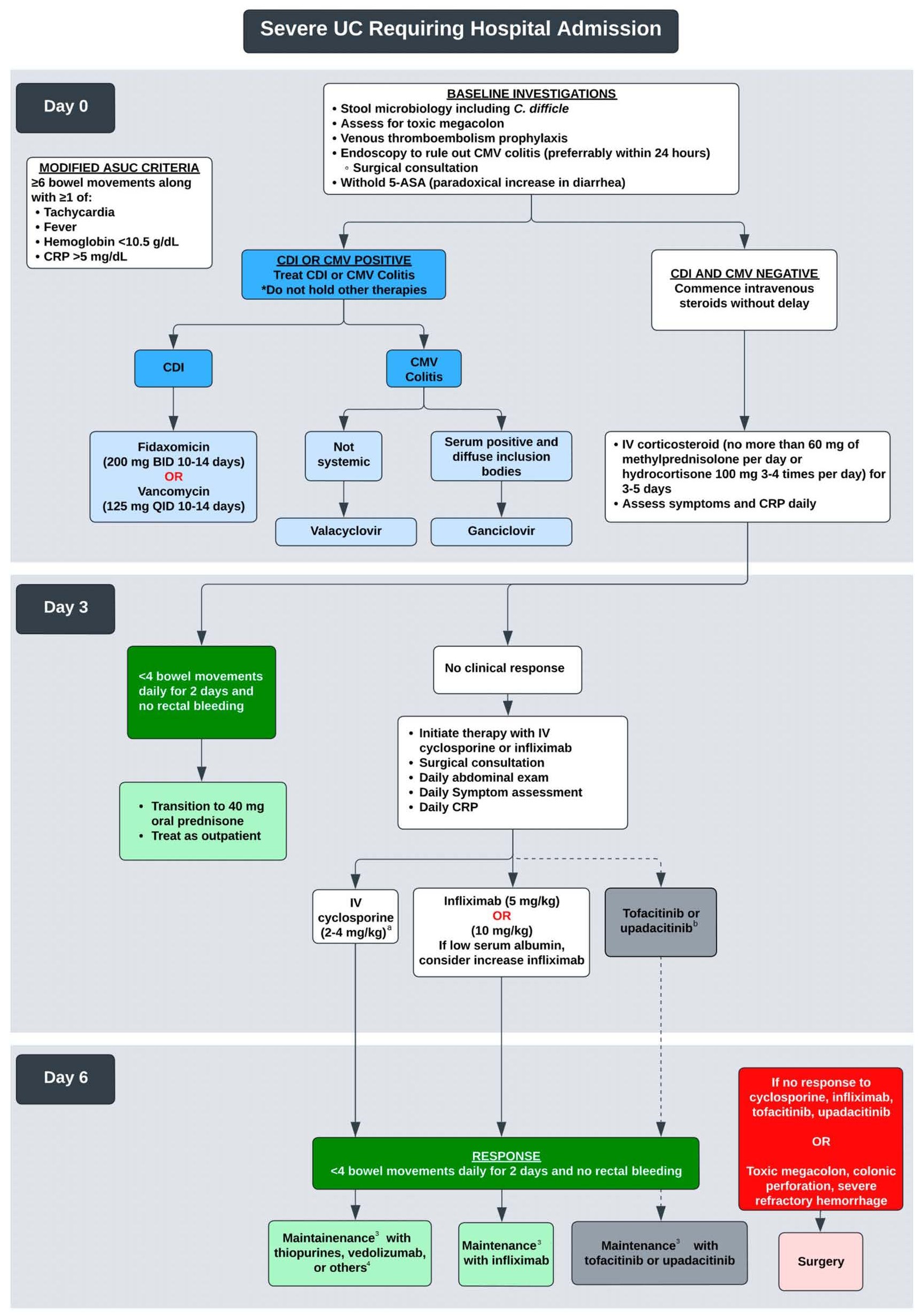
Figure 1. Algorithm for the management of hospitalized patients with acute severe UC. 5-ASA, 5-aminosalicylic acid; ASUC, acute severe ulcerative colitis; BID, twice daily; CDI, Clostridioides difficile infection; CMV, cytomegalovirus; CRP, C-reactive protein; IV, intravenous; QID, 4 times a day; UC, ulcerative colitis. Access this figure in the guideline.

COMMENTARY
Why Is This Important?
There are 1.3 million individuals living in the United States with UC3. The disease is chronic and complex, affecting the large bowel and causes significant morbidity. These updated clinical guideline help provide guidance to gastroenterological physicians and APPs managing UC patients in different clinical settings, especially in areas where access to IBD-trained physicians and APPs or dedicated centers may be limited.
Key Study Findings
There is a re-instated emphasis on integrating all data available when managing UC patients: clinical, endoscopic, histological and biochemical. We currently have eight advanced therapies that are approved to get patients off steroids and in remission.
Caution
The major limitation is the paucity of head-to-head trials that could help position our advanced therapies.
My Practice
My practice aligns with the new ACG clinical guidelines for the management of UC adult patients. My approach is to continuously integrate the dynamic changes happening with my patients and provide them with treatment plans that are tailored to them. I attempt to remain updated on their symptoms, most recent endoscopic and histological findings, biochemical markers and new comorbidities that are being diagnosed with. When appropriate, I present them with the available therapeutic plans that would fit their medical and personal needs. For example, patients with non-flexible schedules such as workers with non-traditional shifts might choose a subcutaneous injection that they can do at their own schedule, rather than a scheduled infusion. Again, these are all dynamic and are subject to change, hence I make sure that the therapies provided are the most beneficial to them at their most recent encounter, based on informed-consent and patient-centered decision making.
In addition, my patients and I are fortunate that my practice is part of a large multidisciplinary center where we have easy access to colorectal surgery, nutrition support and behavioral health. The new ACG guidelines also put added emphasis on involving these consultants at an earlier stage to help prevent any added comorbidities to UC patients.
For Future Research
New evidence is needed to investigate the benefit of integrating intestinal ultrasound in the management of UC. In addition, there is a possible push to achieve histological remission as a target-to-treat. In addition, researchers can focus on creating new studies with higher quality of evidence to validate the key concepts proposed here and make them into guidelines recommendations.
Conflict of Interest
Dr. Al Kazzi reports no relevant conflicts of interest.
Abbreviations
ASUC, acute severe ulcerative colitis; CRP, C-reactive protein; FC, fecal calprotectin; HRQoL, health-related quality of life; MES, Mayo Endoscopic Score ; PICO, Patient Intervention Com-parison and Outcomes; UC, ulcerative colitis.
REFERENCES
- AGREE Next Steps Consortium (2017). The AGREE II Instrument [Electronic version]. https://www.agreetrust.org/resource-centre/agree-ii/. Accessed August 4, 2025.
- Brouwers MC, Kho ME, Browman GP, et al. AGREE II: Advancing guideline development, reporting and evaluation in healthcare. CMAJ 2010;182:E839-842.
- Lewis JD, Parlett LE, Jonsson Funk ML, et al. Incidence, prevalence, and racial and ethnic distribution of inflammatory bowel disease in the United States. Gastroenterology 2023;165(5):1197–205.e2.