

Empirical Antifungals Improve Survival in ACLF
 Christina N. Awad, MD

Associate Professor, Division of Gastroenterology and Hepatology, Department of Medicine, UT Health San Antonio, San Antonio, Texas
This summary reviews Verma N, Valsan A, Garg P, et al. Empirical antifungal therapy improves survival in patients with acute-on-chronic liver failure with suspected invasive fungal infections: a pragmatic randomized trial. Am J Gastroenterol 2026;121(9):2198–2210.
Access the article through The American Journal of Gastroenterology
Correspondence to Christina N. Awad, MD. Associate Editor. Email: EBGI@gi.org
Keywords: Antifungal therapy, acute-on-chronic liver failure, fungal infections, randomized trial
STRUCTURED ABSTRACT
Question: In hospitalized patients with acute-on-chronic liver failure (ACLF) and suspected invasive fungal infection (IFI), does early empirical antifungal therapy based on clinical suspicion improve 28-day survival compared with a diagnostic/biomarker-driven pre-emptive strategy?
Design: This study was a pragmatic, parallel-group, open-label, randomized controlled trial with blinded endpoint adjudication. P atients were randomized 1:1 to empirical versus diagnostic/biomarker-driven pre-emptive antifungal therapy, N = 216; 108 patients per group. The primary analysis was performed in the intention-to-treat population.
Setting: It was conducted in a large tertiary-care center with dedicated hepatology services in India with a high burden of IFI. Enrollment occurred from November 7, 2019 through December 31, 2024
Patients: Patients were adults 18 years or older with ACLF according to European Association for the Study of Liver or Asian Pacific Association for the Study of the Liver criteria and clinical suspicion for IFI.
They were required to have an intensive care unit stay of more than 48 hours or recent hospitalization for the current illness; 2 or more additional IFI risk factors such as mechanical ventilation, broad-spectrum antibiotics, central venous catheters, diabetes, malnutrition, renal replacement therapy, or high disease-severity scores; along with at least 2 clinical criteria suggesting IFI, including persistent sepsis/systemic inflammatory response despite appropriate antibiotics, recurrent fever, unexplained worsening organ dysfunction, or findings suggesting fungal infection at another site. Major exclusions: neutropenia, recent antifungal therapy, HIV infection, pregnancy, hepatocellular carcinoma, and moribund status with 4 or more organ failures.
The population was predominantly male, with alcohol-related cirrhosis representing the most common underlying liver disease.
Interventions: For the empirical therapy group, systemic antifungal therapy was initiated at randomization based on predefined clinical suspicion and risk factors, without waiting for confirmatory testing.
The pre-emptive therapy group’s antifungal therapy was initiated only after predefined radiologic, mycologic, or biomarker evidence supported IFI. Antifungal selection was left to the treating physicians. Liposomal amphotericin B was the most frequently used agent. Both arms incorporated biomarker- and culture-guided antifungal stewardship, including protocolized treatment de-escalation when appropriate.
A clinically important difference was treatment timing: median time from admission to antifungal initiation was 4 days with empirical therapy versus 7.5 days with the pre-emptive strategy.
Outcomes: The primary outcome was 28-day overall survival. Secondary outcomes were in-hospital mortality; changes in model for end-stage liver disease, model for end‑stage liver disease-sodium, CLIF-C OF, and CLIF-C ACLF scores; fungal biomarker trends; mechanical ventilation-free days; intensive care unit and hospital length of stay; nosocomial infections; adverse and serious adverse events; and cost-effectiveness. The investigators also evaluated IFI resolution, treatment success, and heterogeneity of treatment effects.
Data Analysis: The primary survival analysis used Kaplan-Meier estimates and the log-rank test. Cox proportional hazards regression adjusted for baseline disease severity, including model for end‑stage liver disease, CLIF-C OF, and ACLF grade. Because the proportional hazards assumption was violated, the investigators supplemented the Cox analysis with restricted mean survival time and landmark analyses. Missing data were not imputed, and multiplicity adjustment was not performed for exploratory subgroup analyses.
Funding: The study was funded by the Indian Council of Medical Research, with the award made to Nipun Verma. The authors reported that the funder had no role in study design, conduct, analysis, or reporting.
Results: A total of 216 patients were randomized: 108 to empirical therapy and 108 to the diagnostic/biomarker-driven pre-emptive strategy. Twenty-eight day survival was significantly higher with empirical therapy: 35% vs 13% Hazard ratio: 0.64; 95% confidence interval (CI): 0.47–0.88; P = 0.005. This corresponded to an approximate number needed to treat of 5.
Other findings favored empirical treatment, as shown in Table 1.
IFI-attributable mortality and clinical resolution were significantly improved with empirical therapy.
Empirical therapy was also associated with less ventilator dependence and less progression of organ failure. Adverse events were not increased; overall adverse events were actually reported less frequently in the empirical arm.
The economic analysis found a higher upfront treatment cost but greater health benefit, with an incremental cost-effectiveness ratio of approximately $1,626 per quality adjusted life year gained, below the prespecified Indian willingness-to-pay threshold.
| Outcome | Empirical | Pre-emptive |
| 28-day survival | 35% | 13% |
| In-hospital mortality | 55.6% | 71.3% |
| IFI-attributable mortality | 55.6% | 75.9% |
| IFI-clinical resolution | 45.8% | 22.5% |
| Treatment success | 37.4% | 16.9% |
Table 1. Comparison of empirical vs pre-emptive treatment outcomes
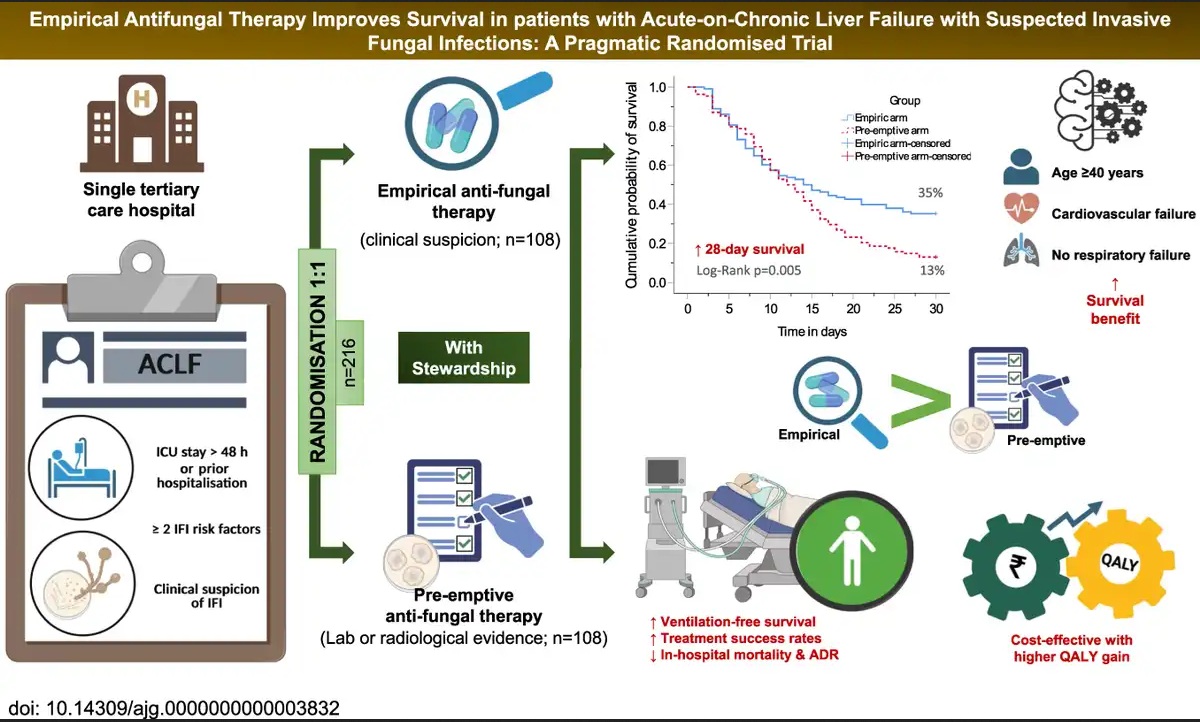
Figure 1. Visual abstract for empirical antifungal therapy improves survival in patients with acute-on-chronic liver failure with suspected invasive fungal infections: a pragmatic randomized trial.

COMMENTARY
Why Is This Important?
The diagnosis of invasive fungal infections in patients with acute-on-chronic liver failure remains challenging because clinical manifestations are often nonspecific, while fungal cultures may be slow to yield results and have limited sensitivity. These diagnostic limitations complicate decisions regarding when to initiate antifungal therapy, particularly in critically ill patients with multiple risk factors. This randomized trial addresses an important clinical question by directly comparing outcomes with empiric antifungal therapy versus a diagnostic- and biomarker-guided treatment strategy in patients with ACLF.
Key Study Findings
In this prospective randomized trial, 216 hospitalized patients with ACLF and predefined risk factors plus clinical suspicion for IFI were randomized 1:1 to immediate empirical antifungal therapy or to a diagnostic/biomarker-driven pre-emptive strategy. Both groups used antifungal stewardship incorporating clinical response. At 28 days, survival was significantly higher with empirical therapy: 35% vs 13%, with a hazard ratio for mortality of 0.64 (95% CI 0.47-0.88; P=0.005). This corresponded to a number needed to treat of approximately 5. Empirical therapy was also associated with greater IFI resolution (45.8% vs 22.5%), higher treatment success (37.4% vs 16.9%), and lower in-hospital mortality (55.6% vs 71.3%).
Thus, the trial suggests that in highly selected patients with ACLF and strong suspicion for IFI, empiric antifungal treatment may improve clinical outcomes.
Caution
These results do not recommend empiric antifungal therapy for all hospitalized patients with ACLF. This study included a high-risk patient population meeting multiple criteria for treatment.
Generalizability is limited as well. This is a single-center study from a tertiary hepatology center in India; 92% of participants were male and nearly 80% had alcohol-related cirrhosis.
My Practice
This trial would make me more proactive about considering fungal infection early in a patient with ACLF, particularly in the setting of alcohol-associated hepatitis, who is deteriorating despite appropriate antibacterial therapy, particularly when multiple IFI risk factors are present.
In carefully selected, high-risk patients with ACLF and suspected IFI, I would consider treatment early as I investigate/diagnose and de-escalate accordingly.
For Future Research
This study should be validated in a multicenter and geographically diverse populations with an assorted group of advanced liver disease etiologies. Future studies could also investigate the most optimal antifungal agent to use and the treatment duration.
Conflict of Interest
Dr. Awad has no conflict of interest.
@DrAwadMD